
A reverse proxy is a server that accepts requests from users and passes them to one or more backend services. What is a reverse proxy and why use Nginx? This is a crucial question for anyone learning about web servers, networking, cloud computing, or cybersecurity. By sitting between the users and the backend applications, a reverse proxy can increase performance, security, scalability and availability for an application. Nginx is frequently used for this purpose. It can efficiently handle reverse proxying, load balancing, caching, TLS termination, and HTTP traffic.
What Is A Reverse Proxy?
A reverse proxy is a server that sits between the clients and the backend servers. The browser does not connect directly to the application server, but sends the request through the reverse proxy.
The reverse proxy then handles the request and passes it on to the correct backend server. The backend generates the response, which is then sent to the user via the reverse proxy.
As an example, take a website with the following architecture:
User → Reverse Proxy → Application Server → Database
Usually the user just sees the public-facing reverse proxy. The internal application server can be isolated from the Internet directly.
NIST defines reverse proxies as “systems that sit between the web servers and their clients. NIST also points out that reverse proxies can perform security functions, assisting with activities like SSL/TLS processing.
How Does A Reverse Proxy Work?
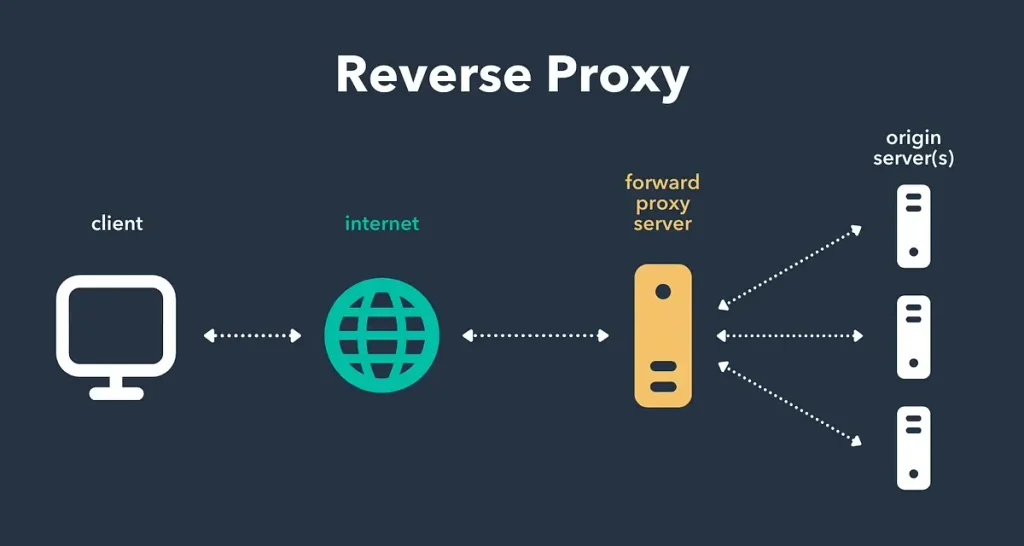
When a visitor visits a website, a number of things can happen:
- User enters a website address.
- The domain is resolved by DNS to the public server.
- The request goes to the reverse proxy,
- The reverse proxy determines where the request should go.
- The request is sent to a backend program.
- The backend handles the request.
- The response goes back to the reverse proxy.
- The reverse proxy provides the response back to the user.
This architecture allows to segregate the public entry point from the application infrastructure of organisations.
For example, Nginx can listen for HTTPS traffic on the public interface and redirect requests to an application listening on a different port such as localhost:8000. Its proxy_pass directive is intended to pass requests to another server.
Reverse Proxy Vs Forward Proxy
Both a reverse proxy and a forward proxy are intermediaries but perform different jobs.
Usually a forward proxy stands in for the client. The client sends requests through the proxy to access external services.
The server or application infrastructure is a reverse proxy. The users connect to the reverse proxy which in turn talks with back end servers.
For instance:
Forward proxy:
User → Forward Proxy → Internet
Reverse proxy:
User → Reverse Proxy → Web Server
Reverse proxies are widely used in websites, APIs, cloud applications, microservices and enterprise contexts.
Why Nginx Is Used As A Reverse Proxy?
Nginx is popular because it combines web server and proxy capabilities in one lightweight platform. According to the official Nginx documentation, it is an HTTP web server, reverse proxy, content cache, load balancer, and TCP/UDP proxy server.
Some of the main reasons why organisations choose Nginx as reverse proxy are:
1. Load Balancing
A busy website could have numerous application servers instead of a single server.
Nginx can balance the load of incoming requests to several backend servers. Its HTTP load-balancing feature can employ techniques like as round-robin to distribute requests over a pool of servers.
For example:
Users → Nginx → Server 1 / Server 2 / Server 3
Applications can support a larger number of concurrent queries.
2. TLS Termination
Nginx can terminate HTTPS at the front end and communicate with backend apps separately.
This helps to reduce the amount of TLS processing required by specific backend servers. NIST lists encryption acceleration and SSL/TLS processing as possible reverse proxy functionalities.
But when important traffic has to be encrypted, organisations should nevertheless correctly implement encryption between internal components.
3. Hiding the Back-End Infrastructure
A reverse proxy can offer an additional layer between the public internet and application servers.
The users communicate with the public facing proxy, not directly with the backend services. Microsoft explains reverse-proxy topologies where traffic ends at the proxy and a separate connection is formed with the backend application.
This can decrease the direct exposure of internal application infrastructure.
But you don’t want to think of a reverse proxy as a fully-fledged security solution. Firewalls, authentication, authorisation, secure application development, patching and monitoring are still vital.
4. Improving Performance
Nginx can cache some stuff and serve static files well .
Caching helps to reduce repetitive requests to backend apps. This is especially helpful for sites that deliver photos, CSS files, JavaScript and other static resources.
Nginx also supports a variety of HTTP protocols and features, including HTTP/2 and HTTP/3.
5. Application Routing
A reverse proxy can route based on domains or URL paths.
For example:
example.com/blog → Blog server
example.com/api → API server
example.com/shop → E-commerce server
This enables various apps or services behind one single public entry point.
Nginx uses server and location configuration to decide how to handle incoming requests.
6. Microservices Architecture
Modern applications are built from a number of distinct services.
Instead of making each service available directly to the internet, Nginx can operate as a gateway between the users and the services.
For example:
User → Nginx → Authentication Service
User → Nginx → Payment API
User → Nginx → Product Service
This creates a centralized location for routing and traffic control.
Nginx Reverse Proxy Example
A basic Nginx reverse-proxy configuration can look like this:
server {
listen 80;
server_name example.com;
location / {
proxy_pass http://localhost:8000;
proxy_set_header Host $host;
proxy_set_header X-Real-IP $remote_addr;
}
}
Here Nginx listens for incoming HTTP requests and sends them to an application running on port 8000.
You can find similar examples with proxy_pass and request header in the official Nginx documentation.
In a production environment, the configuration should be adjusted to the application, network architecture, authentication requirements, TLS settings, logging, and security policies.
Security Benefits Of A Reverse Proxy
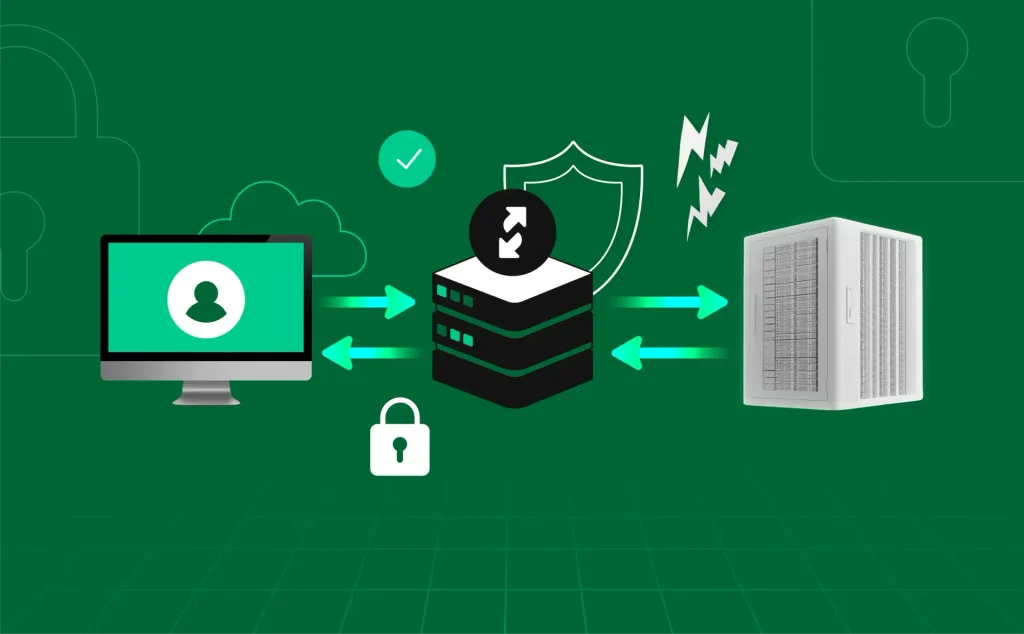
A reverse proxy can help in a defence in depth architecture.
It can provide a central point for traffic management, TLS handling, request routing, control of access, logging and other controls.
Proxy-based architectures provide a means to inject policy enforcement between consumers and apps, according to Google . Google Cloud’s security proxy services also illustrate how proxy layers can inspect traffic and implement access controls.
Microsoft also provides documentation for reverse-proxy systems that can enable authentication and prohibit direct HTTP access to back-end servers.
But admins shouldn’t assume deploying Nginx is an automatic way to defend an app. Vulnerable applications, insufficient authentication, unprotected setups, old software and exposed backend services can still generate security problems.
Reverse Proxy Use Cases
Common uses of reverse proxies are:
- Websites
- REST APIs
- Cloud applications
- Microservices
- E-commerce platforms
- Internal business applications
- Load balancing
- HTTPS termination
- Content caching
- Application gateways
- Kubernetes ingress architectures
Nginx can also be used as a reverse proxy for a range of application technologies such as FastCGI, uWSGI, SCGI and gRPC services.
Why Nginx Is Popular For Web Applications?
Nginx is event-driven and decouples its master and worker processes. The official documentation refers to worker processes as the processes that actually handle the requests.
This architecture helps Nginx to efficiently deal with multiple connections.
And it’s so popular because it’s so versatile. That same platform may serve static files, reverse proxy, load balance, cache, and serve many sorts of network traffic.
And for orgs running several services, the ability to do this in one platform helps simplify the whole web architecture.
What Are The Limitations Of A Reverse Proxy?
Reverse proxies offer useful capabilities , but they require more configuration too .
Incorrect forwarding headers may be the cause of authentication or redirection problems. Proxy designs may modify request information such as the scheme, host, port, and path, and Microsoft indicates the applications may have to deal with this correctly.
Other possible issues:
- Incorrect TLS configuration
- Improper access controls
- Misconfigured forwarded headers
- Backend servers accidentally exposed
- Incorrect caching rules
- Missing security updates
- Inadequate logging
- Incorrect routing rules
It is recommended that administrators constantly evaluate the proxy configuration and maintain Nginx and related components patched.
Reverse Proxy And Cybersecurity

From a cybersecurity standpoint, a reverse proxy might be one part of a layered security architecture.
It can assist segregate public facing services from backend infrastructure, and give a centralised place for some security measures.
It should however function in conjunction with additional protections such as Web Application Firewall, secure authentication, authorisation, network segmentation, monitoring, vulnerability management and application security testing.
Take Google’s application-security services, for example. They incorporate WAF, API protection, anti-DDoS controls, and other security capabilities, not just a proxy.
Conclusion
Reverse proxy and why we choose Nginx? is consequently valuable for anyone who is studying networking or cybersecurity. Nginx provides the infrastructure to route, balance, cache and manage web traffic, while additional security controls safeguard the applications behind it.
Frequently Asked Questions
1. What is reverse proxy in simple language?
A reverse proxy is a server that sits in front of users and backend servers. The reverse proxy receives requests from the users and redirects the requests to the appropriate application server and then returns the result to the user.
2. Why use Nginx as a reverse proxy?
We chose Nginx because it can do reverse proxying, load balancing, caching, TLS handling, serving static content, and application routing. Its architecture is optimised to manage a high number of network connections efficiently.
3. Does a reverse proxy add security?
A reverse proxy adds an extra layer of security between the users and the backend servers. However, it does not substitute authentication, authorisation, firewalls, secure application development, patching, monitoring or other security controls.
4. Can Nginx use more than one backend server?
Yes. Nginx can do load-balancing, distributing requests over different back-end servers. This can allow apps to load balance and increase availability.
5. Nginx is merely a reverse proxy?
No. Nginx may also be a web server, content cache, load balancer and a TCP/UDP proxy. It can serve static files and proxy a variety of application protocols.
Try Our Tools
If you want to learn about the fundamentals of networking and cyber security, check the Try our tools area of ExplainMeTech. You can find helpful web tools for practical technology, security and digital tasks.
Reference Sources
- NIST – Guidelines on Securing Public Web Servers — Reverse proxy and web-server security guidance.
- OWASP — Application and web security guidance.
- Nginx Official Documentation — Reverse proxy, proxy configuration, and load balancing documentation.
- Microsoft Learn — Reverse-proxy deployment and security considerations.
- Google Cloud Security — Proxy, application protection, and security architecture guidance.
Find more useful information about technology, cybersecurity and digital security at ExplainMeTech.com where you can explore our latest guides, tools and insights.