
When you hear the terms vulnerability, threat and risk in relation to cybersecurity it might be confused. The words are similar, but each describes a different aspect of a security problem.
That difference is significant to everyone from those just starting to sign up for internet accounts to corporations protecting client data.
In simple terms:
Vulnerability = A weakness
Threat = A possible danger that could take advantage of the deficiency.
Risk = The likelihood and impact of that hazard causing harm.
Take, for example, a house with an unlocked window. The unlocked window is the weak spot. The burglar is the danger. The burglar may enter and take important goods. There is a risk.
The core premise is the same for cybersecurity, too.
What Is A Security Vulnerability?
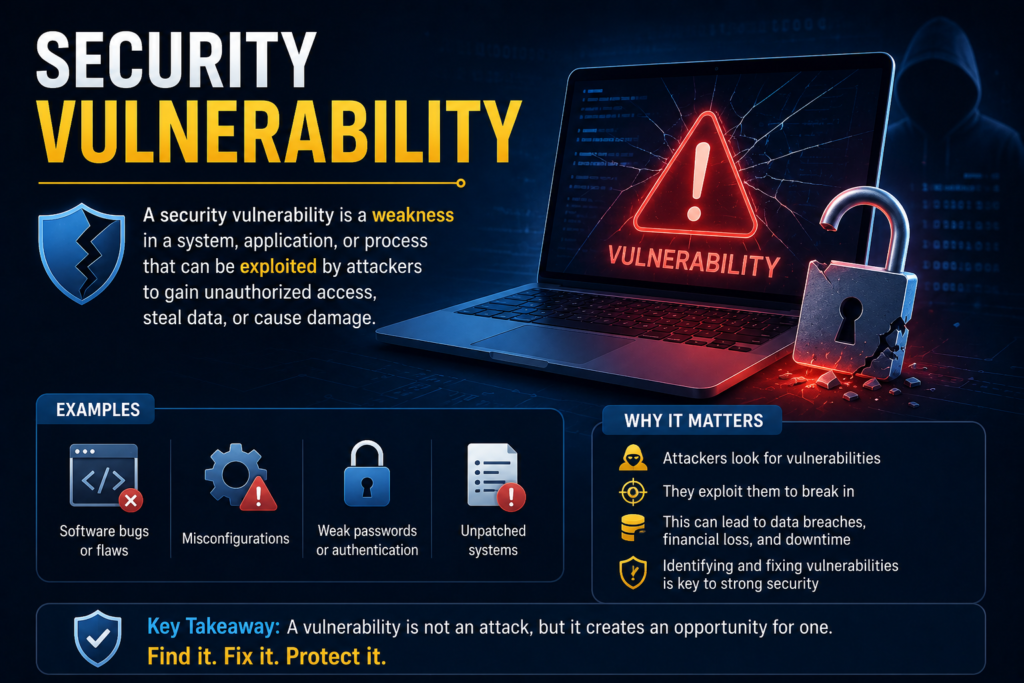
A security vulnerability is a weakness or flaw in a computer system, application, network, device, process or security control which could possibly be exploited.
A Vulnerability is a flaw or weakness in an information system, security procedures, internal controls, or implementation that could be exercised or triggered by a threat source according to NIST .
The OWASP also classifies vulnerabilities as flaws in the design or implementation of software that can be exploited by an attacker to cause damage.
Vulnerabilities can be of several types including:
- Old software
- Weak/recycled passwords
- Lack of security updates
- Weak control of access
- Invalid Input Validation
- Servers misconfigured
- Databases without protection
- Unsecured APIs
- Badly built authentication schemes
- Weak security monitoring
A vulnerability is not a sign that an attack has already transpired. It suggests there is a vulnerability that could be exploited.
Common Example Of A Vulnerability
Say that a corporation is running a legacy version of a web application that has a known security hole.
The attacker is not the vulnerable program. Therein lies the weak point where an attacker may find a chance.
This is a major distinction since security teams tend to identify and repair flaws before anyone can attack them successfully.
What Is A Cybersecurity Threat?
A danger is something that can potentially cause harm to a system, organization, device or person.
A danger could be a malevolent attacker, malware, an insider, unintentional human behaviour, system failure or some other situation.
NIST defines a threat as “a circumstance or event with the potential to adversely impact operations, assets, or individuals thru an information system”.
OWASP defines a threat as an external attacker, internal user, system instability or other that could impact important application assets by exploiting a vulnerability.
The cybersecurity threats are:
- Cyber-thieves
- Phishing campaigns
- Malware
- Ransomeware
- Credential Stealing
- Threats from insiders
- Bots
- Social engineering
- Denial of Service Attacks
A vulnerability is not the same as a threat.
The weakness is the achilles heel. The threat is the possible cause of danger.
What Is Cybersecurity Risk?
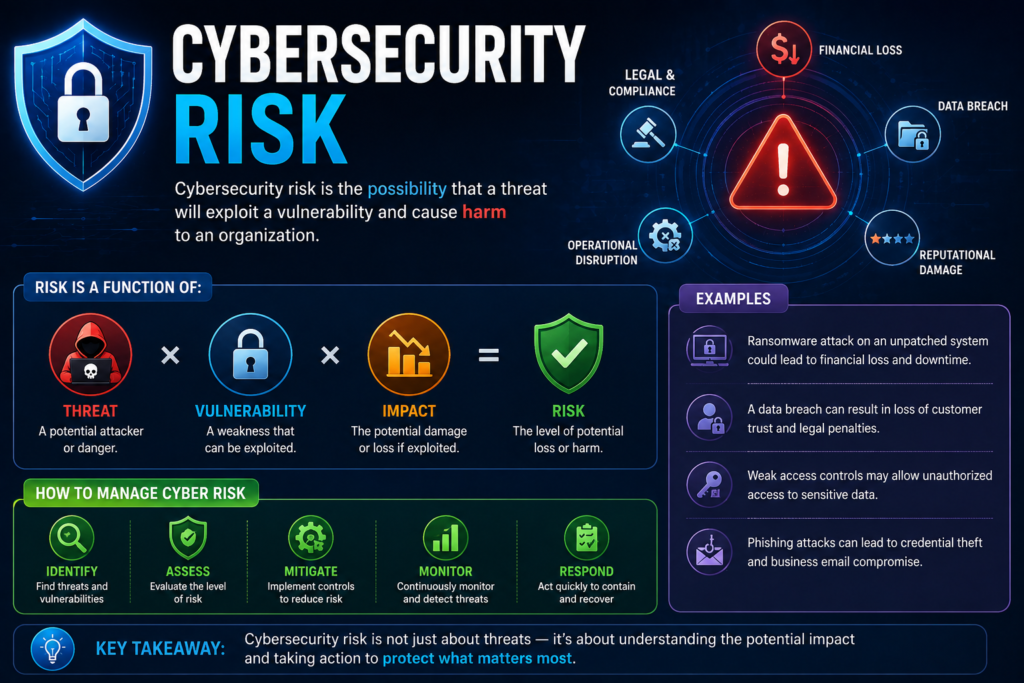
Cybersecurity risk is the probability that a threat could exploit a vulnerability and cause harm.
NIST defines risk as the extent of exposure of an entity to a prospective event, typically a combination of the likelihood of occurrence and the effect of that event.
This is why cybersecurity specialists don’t just ask, “Is this vulnerability here?”
They also enquire:
How much of a target?
Who would use it?
What information might you obtain?
How much is that data worth?
What would happen if the attack worked?
How fast might the organization recover?
Just because a vulnerability exists doesn’t mean the risk is the same in every case.
For example, the low-risk vulnerability in stand-on My Take a Look at Machine may be of remarkably low risk. The same kind of vulnerability on a server that maintains sensitive user records could mean a much bigger threat.
Vulnerability Vs Threat Vs Risk
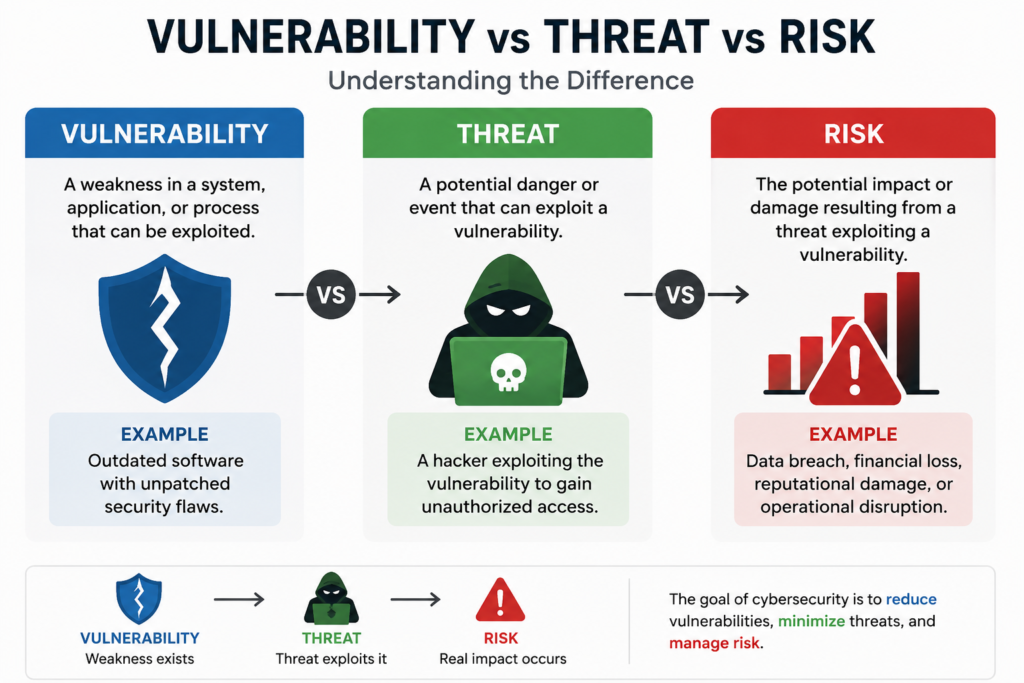
| Concept | Meaning | Simple Example |
| Vulnerability | A weakness | An outdated application |
| Threat | A potential danger | A cybercriminal looking for vulnerable systems |
| Risk | Likelihood and potential impact of exploitation | The possibility of customer data being stolen |
| Attack | An attempt to exploit a weakness | An attacker exploiting the outdated software |
| Impact | The damage caused | Data loss, financial loss, or downtime |
The easiest way to remember the difference is:
Weakness → Danger → Possible Harm
Or:
Vulnerability → Threat → Risk
But risk is not simply the existence of a threat and a vulnerability. In practical risk analysis organisations take into consideration likelihood, possible impact, existing controls and the environment.
How Vulnerabilities, Threats, And Risks Work Together?
Think of a website.
“There is a piece of old software on the website that has been identified as having a security flaw.This is the vulnerability.
A cybercriminal scans the internet for websites that may have prone variations of the software. The crisis? Cybercriminals.
The business organization is at risk if the attacker effectively exploits the vulnerability and gains access to the buyer’s data.
Possible outcomes could be:
- Customer data exposure
- Financial losses
- Business interruption
- Reputation damage
- Legal or regulatory consequences
- Loss of customer trust
Security teams want to reduce risk by discovering vulnerabilities, evaluating threats, and deploying the right security measures.
Realistic Example
Weak Password
Imagine an employee has a primary password for their email and possibly other internet logins.
A weakness is a weak and overused password.
A cybercriminal obtains passwords from a phishing attack or a prior breach. The threat is wrong.
If a stolen password is used by an attacker to access an employee’s graphics, the business enterprise is at risk.
It could potentially provide unauthorized access to company email, files, user directories, or other internal systems.
Use a lengthy and unique password and enable multi-factor authentication to greatly increase the security of your accounts.
Unpatched Business Software
Consider a small business running an old version of its customer-management software.
There is a known security vulnerability but the available security update has not been implemented by the firm.
The vulnerability is the obsolete software.
The threat is that attackers scan the Internet looking for susceptible computers.
Business risk: The weakness could be exploited by an attacker to access consumer records.
This can result in data theft, service disruption, financial losses and damage to the company’s brand.
Regular software updates, vulnerability scanning, management of access, backups and monitoring can lessen this danger.
Why Understanding These Differences Matters?
Understanding the distinctions between vulnerability, threat, and risk allows individuals and organisations to make better security decisions.
You can wind up with a huge list of technical issues, but no sense of which ones to address immediately, if you merely hunt for vulnerabilities.
Risk-based security allows you to prioritise vulnerabilities by probability and impact.
If a serious vulnerability is present in an internet-facing server that contains sensitive data, it may need to be addressed immediately.
A low-impact vulnerability on an isolated system may not require the same urgency.
Microsoft’s approach to threat, vulnerability and risk assessment also includes risk in relation to threats, vulnerabilities, likelihood, impact and effectiveness of existing measures.
How To Reduce Security Vulnerabilities And Risk?
Some specific initiatives that individuals and corporations can take to strengthen cybersecurity include:
1. Keep Software Updated
Patch and update operating systems, programs, browsers, plug-ins and other software with security updates.
2. Create Strong and Unique Passwords
Don’t use basic or overused passwords. Each major account should have a different password.
3. Turn on Multi-Factor Authentication
MFA adds an additional layer of security if a password is compromised.
4. Control User Access
Users should have only the rights that they actually require. Limiting unneeded rights can decrease the amount of damage hijacked accounts can do.
5. Monitor Systems
Security logs, warnings and monitoring can assist detect suspicious behaviour before it does major damage.
6. Back Up Important Data
Reliable backups can help organisations recover from ransomware, unintentional deletion, hardware failure and other catastrophes.
7. Conduct Regular Security Assessments
Routine vulnerability assessments and security testing can help detect holes before attackers exploit them.
Create A Strong Password With Our Password Generator
Weak and repeated passwords remain a major security worry. A quick and easy approach to strengthen your account security is to use a strong, unique password for each of your critical accounts.
Forget about establishing a predictable password manually, with our Password Generator, you can get a powerful random password.
Check out our Password Generator: https://explainmetech.com/tools/password-generator/
You can use the generated password for accounts that would be suited for unique, hard to guess credentials. Never use the same password for different services. Keep your key passwords private.
Final Words
Understanding vulnerability versus threat versus risk is one of the building blocks of cybersecurity.
A weak point is a weakness. Contingency is a possible combination that can maximize vulnerability. Risk is the beneficial impact of a security event and the potential for harm.
Recall the simple relationship:
Vulnerability = Weakness Threat = Possible Danger Risk = Probability + Impact
Early detection of vulnerabilities, understanding threats to your systems, and prioritizing the most tangible risks allows you to establish a more powerful protection strategy.
Frequently Asked Questions
1. What do you mean by cybersecurity vulnerabilities?
A vulnerability is a weak spot or flaw in the implementation of a device, utility, device, technology, or protection that can be exploited through a threat source .
2. What is the difference between vulnerability and risk?
A weakness is a weakness. Threat: A capability source or event that can exploit a weakness to deal damage.
For example, an old utility becomes a weakness, and a cybercriminal looking to make the most of it is apt to be an opportunity.
3. Is a vulnerability necessarily a security risk?
Not always. Risk is a function of variables with potential for exploitation and the impact of maximizing such, it should be done. An isolated device with a vulnerability is not as dangerous as a fully exposed device with sensitive information.
4. Is a threat possible without vulnerability?
Indeed. Even if it is not possible to determine the use of for a particular system, the risk may still be present. Strong safety controls can make the burden harder for the hazard to cause harm.
5. How do I reduce cybersecurity risk?
Update software applications, use strong unique passwords, enable MFA, restrict access rights, set up backups, expose critical systems, and check for vulnerabilities regularly.
Reference Sources
OWASP – Vulnerabilities
OWASP – Vulnerabilities
OWASP – Web Security Testing Guide
OWASP – Web Security Testing Guide
NIST – Cybersecurity Glossary
NIST – Cybersecurity Glossary
Microsoft – Threat, Vulnerability, and Risk Assessment
Microsoft – Threat, Vulnerability, and Risk Assessment
CISA – Cybersecurity Resources
CISA – Cybersecurity Resources
Visit ExplainMeTech.com for more practical technology and cybersecurity knowledge, get more easy-to-follow guides, digital safety advice and security insights.