
Artificial intelligence has advanced from a software trend to a large infrastructural competition. A significant amount of computer power sits behind every AI chatbot, picture generator, recommendation engine, coding assistant and autonomous AI agent. This is why firms like Microsoft, Google, Amazon, Meta, NVIDIA, and other major companies are spending billions of dollars on AI infrastructure.
The AI chip is the secret sauce of this investment. To deliver the processing power, modern AI relies on the collaboration of GPUs, TPUs, AI accelerators, CPUs, networking chips, memory, storage, cooling systems and data centers. But what makes AI chips so critical, and why are firms pouring so much money into them?
What Is An AI Chip?
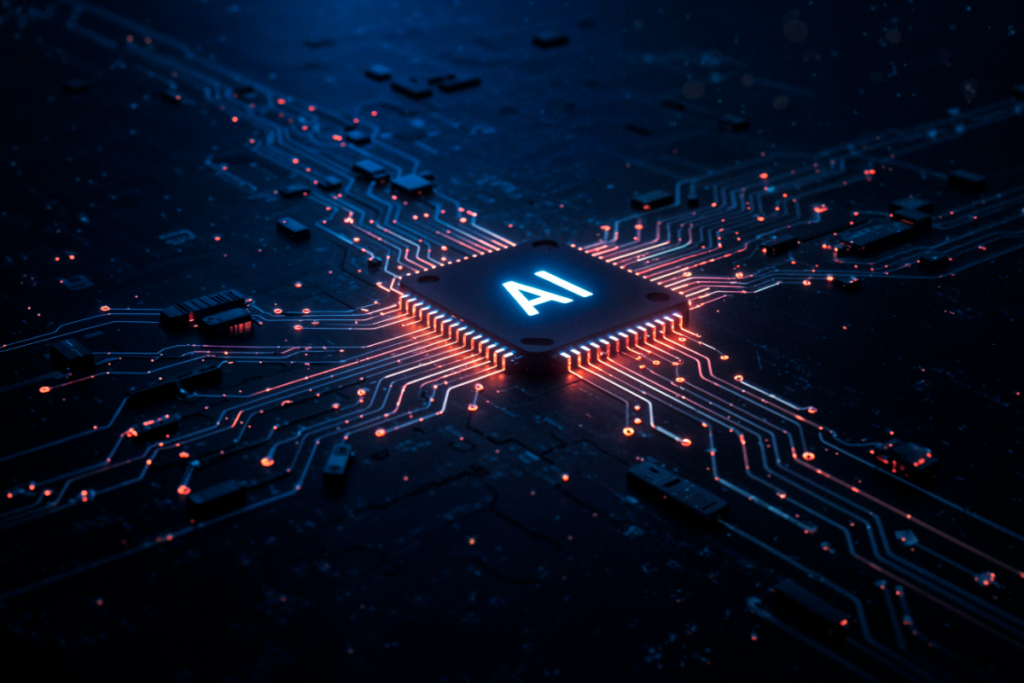
An AI chip is a processor that is developed or optimised to execute the computations required for artificial intelligence and machine learning applications.
Traditional CPU’s are good for general purpose computing. But contemporary AI models conduct a huge amount of calculations all at once. This is where specialised processors like the GPU, TPU and AI accelerators are so valuable.
For example, training a big language model requires consuming vast volumes of data through billions or even trillions of model parameters. Specialised AI gear executes these calculations significantly more effectively than a typical CPU.
For example, NVIDIA’s Blackwell platform is built as part of a whole AI infrastructure system rather than just a single chip. The architecture integrates GPUs, CPUs, networking, memory and other technologies for large scale AI applications.
Why AI Needs So Much Computing Power?
AI models are growing in size and capability. The hardware needed to run machine-learning systems was frequently quite basic in the past. So, today’s foundation models need large amounts of compute during training and inference times.
Training
Training is when you give an AI model a lot of data to learn from. The system goes through the data over and over again, figuring out the errors, tweaking the model’s parameters, and doing this cycle many, many times . This demands huge processing resources with billions of parameters.
Inference
An inference is an answer or prediction made by a trained model.
Whenever someone asks a question of an AI chatbot, creates an image, summarises a document, or utilises an AI coding aid, computational resources are needed to generate the output.
Inference is a huge infrastructure concern as AI systems scale to millions or billions of users.
GPUs Vs. CPUs: Why GPUs Matter
CPUs tend to have fewer strong cores intended to tackle many different types of jobs.
GPUs have plenty of processing units that can do several of the same calculations at the same time. This makes them particularly well suited for AI tasks involving matrix and tensor operations.
Hence AI data centers are designed with huge GPU pools connected with high speed networking.
It is not just a matter of buying a quicker chip. Companies need thousands of processors to connect with each other efficiently, share data, access memory and function together as a single computer system.
NVIDIA said current AI infrastructure is compute, networking, storage, power, cooling and software operating together at data-center scale.
What Are TPUs?
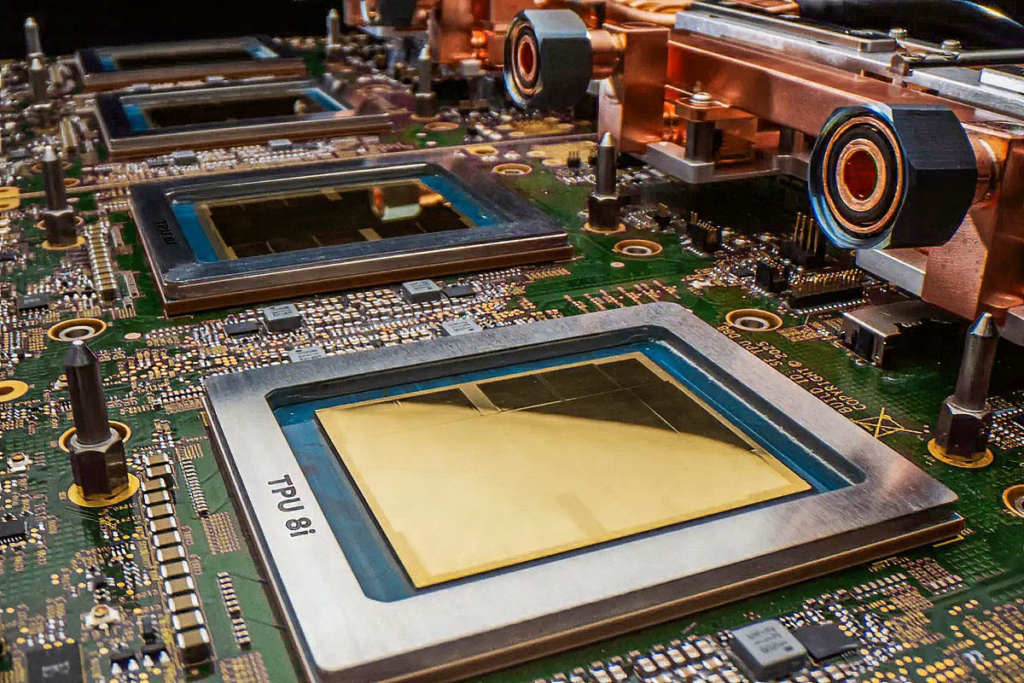
GPUs are not the only CPUs optimised for AI.
Google created Tensor Processing Units (TPUs) for machine-learning tasks. Workloads include huge language models, recommendation systems, computer vision, and generative AI, all running on Google’s TPU infrastructure.
Google revealed its eighth-generation TPUs in 2026, optimised to handle a wide variety of AI tasks, including training and real-time serving. “Our TPU strategy is all about scalability, reliability and efficiency,” Google adds.
This shows an important trend: Companies are building hardware expressly for the AI workloads they plan to run on them.
Why Companies Are Building Their Own AI Chips?
One major reason is cost
Buying a tonne of third-party GPUs can be very pricey. If AI services are deployed at scale, it can be more beneficial for companies to create specialised AI chips optimised for their specific tasks.
Microsoft is one example
Microsoft has built its own Azure Maia AI accelerators and Cobalt CPUs. Microsoft announced Maia 200 in 2026, an AI inference accelerator that aims to enhance the economics of AI token generation.
Google has followed a similar strategy with TPUs
Custom AI chips could enable better performance per dollar, improved energy efficiency, and tighter control of the hardware-software stack.
AI Infrastructure Is More Than Chips
Buying GPUs is an easy way to think of AI infrastructure. But the chip is really just a part of the system.
A big AI data centre also requires:
- High-speed networking
- Advanced memory
- Fast storage
- CPUs
- Power distribution
- Cooling systems
- Data-center buildings
- Software and orchestration
- Security systems
- Monitoring and maintenance
That’s why AI infrastructure investments can add up to massive amounts.
For example, Microsoft’s Azure AI infrastructure integrates computation, networking, storage, accelerated systems, and management technologies to enable model training, fine-tuning, and inference.
Real Example
1: Microsoft Maia 200
Microsoft’s Maia 200 is a good example of why firms are investing in specialised AI chips.
Maia 200 was introduced in January 2026, primarily for AI inference. The accelerator uses a 3nm manufacturing process, has 216GB of HBM3e memory, and is optimised for high-throughput AI token production, Microsoft said.
Rather than depending on general-purpose accelerators, Microsoft might deploy custom AI chips for workloads that relate to its own cloud and AI businesses.
That theoretically can increase performance, efficiency and operating costs at extremely big scale.
2: Google’s TPU Infrastructure
Another major example is Google.
Rather of outsourcing to other GPU providers, Google has been building TPUs for years. Its latest generations of TPUs are custom-designed for Google’s AI workloads and infrastructure.
In 2026, Google introduced the TPU 8t and TPU 8i systems, as well as networking, storage, and orchestration capabilities for massive AI and agentic workloads.
Google’s strategy indicates that the AI chip infrastructure race is evolving into a full-stack battle across semiconductors, software, networking, data centers, and cloud services.
Why Power And Cooling Are Becoming Critical?
AI chips are powerful, but power comes with another problem: electricity and heat.
The massive AI clusters require a lot of electricity. The processors generate heat that must be evacuated using sophisticated cooling systems.
That means an AI data center is about more than buying enough AI chips and CPUs. Businesses also require enough sites, electrical capacity, cooling infrastructure, high-speed networking equipment, and dependable data-center facilities to support powerful AI workloads efficiently.
For example, NIST’s 2026 work on AI data-center security clearly calls out AI infrastructure as a combination of hardware, software, storage, access control, system management, supply chain, power, physical security, and other components.
Security Is Another Major Challenge
The bigger the AI infrastructure, the bigger its potential attack surface.
Artificial intelligence systems are built on models, datasets, APIs, cloud platforms, software packages, storage systems, networking equipment, and MLOps tools.
OWASP highlights concerns such as AI supply-chain assaults, model theft, data poisoning, model poisoning, and other machine learning-specific issues.
The NIST’s draft SP 800-239 also considers security concerns in AI data centers across hardware, including AI chips, software, workflows, storage, and infrastructure.
“This means companies cannot be focused only on performance. AI infrastructure must be built to safeguard models, data, credentials, workloads and networks.
Why The AI Infrastructure Race Will Continue?
AI models are trending toward more complicated reasoning, multimodal capabilities and agentic processes.
AI agents may conduct many steps, call tools, get information and constantly process jobs. Such tasks can require a lot of compute capacity.
So companies want AI chip infrastructure that can run today’s AI workloads, but also be flexible enough to handle whatever models come next.
The contest is also going beyond chips. Companies are vying for data centers, electricity, networking, memory, bespoke silicon, cloud capacity and AI software.
Thus, the AI race is becoming more and more an infrastructure race.
What This Means For The Future?
As the nature of AI workloads continues to grow, AI chips are anticipated to become more specialised.
A single processor might not be suitable for all tasks. Future data centers may use different accelerators for training, inference, reasoning, recommendation systems, AI agents, and other activities.
“Great chips with great software, networking, power management, cooling and security can give companies a massive advantage.”
This is why investing on AI infrastructure is so massive. But they are not just buying computers that are faster. They’re building out the computing infrastructure for the next generation of digital services.
Frequently Asked Questions
1. What is an AI chip?
An AI chip is a CPU that is built or optimised for artificial intelligence workloads. Modern AI models require mathematical computations that GPUs, TPUs and dedicated AI accelerators can execute efficiently.
2. Why are firms pouring billions into AI infrastructure?
Training and inference of AI models require massive amounts of compute. To run large-scale artificial intelligence (AI) systems, companies need processors, data centers, networking, storage, electricity, cooling and software.
3. Is GPU the only chip utilised for AI?
No. Sure, GPUs are popular, but corporations utilise CPUs, TPUs, custom AI accelerators and other specialised processors. Google makes TPUs and Microsoft makes its own Maia AI accelerators and Cobalt CPUs.
4. Why do firms make their own AI chips?
Custom chips can allow enterprises more flexibility over performance, cost, energy efficiency and interaction with their software and cloud platforms. On a large enough scale these advantages can become great.
5. Is AI infrastructure secure?
There are hazards to the AI infrastructure such as supply chain issues, model theft, data poisoning, unauthorised access, and corrupted software components. Organisations need strong identity controls, monitoring, secure configurations, encryption and supply chain security. Both OWASP and NIST give guidelines applicable to safeguarding machine learning and artificial intelligence environments.
Try Our Tools
Looking to beef up your digital security and simplify your day-to-day IT tasks? Try our tools at ExplainMeTech where you may get practical online tools for security, technology and everyday digital needs.
Try Our Tools – https://explainmetech.com/tools/
References
OWASP – GenAI LLM Top 10 2026
OWASP GenAI LLM Top 10 2026
NIST – Artificial Intelligence
NIST Artificial Intelligence
NIST – Adversarial Machine Learning
NIST Adversarial Machine Learning: Taxonomy and Terminology
Microsoft – Maia 200 AI Accelerator
Microsoft Maia 200: AI Accelerator Built for Inference
Google Cloud – TPU 8T and TPU 8I
Google Cloud TPU 8 Technical Deep Dive
For more helpful technology, AI, cybersecurity, and digital security insights, visit ExplainMeTech.com and explore the latest guides, practical tips, and technology resources.