Software Supply Chain Attacks: Most firms spend their security dollars defending the front door: firewalls, phishing training, endpoint technologies. The attackers noticed and several of them stopped knocking. Instead, they sneak inside the software you already trust and let you carry the threat inside your own network. That’s the fundamental principle underpinning software supply chain assaults, which is why they have become one of the major issues in modern cybersecurity.
In this book, we’ll walk over how software supply chain assaults happen, the genuine occurrences that define the area, and the practical steps your team can take to mitigate risk.
What Is A Software Supply Chain?
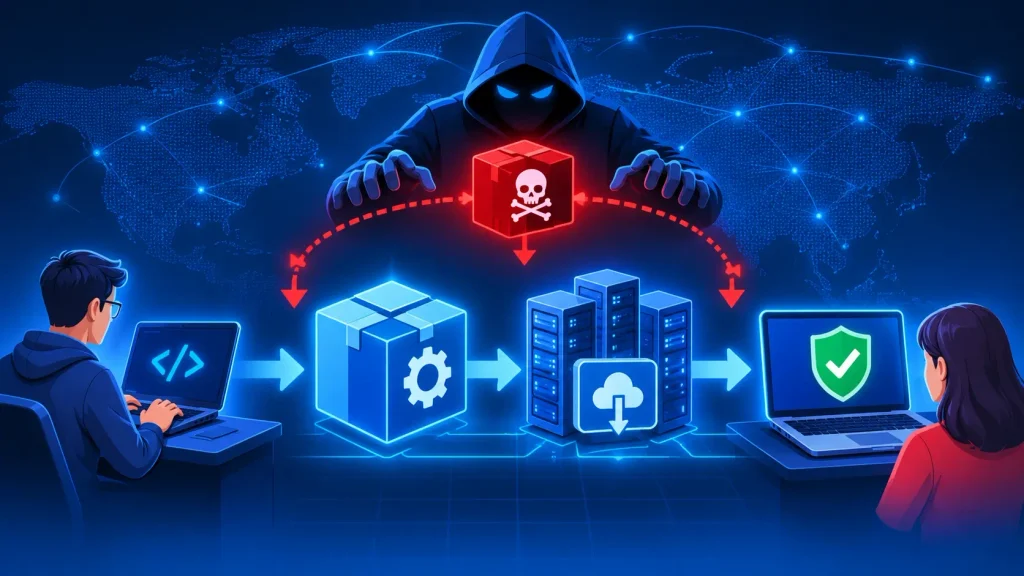
“Software supply chain is everything that touches your code on the way to production. This includes the open source libraries you import, the frameworks and plugins you use, the build servers that compile your application, the container images you deploy, and the vendors that ship you updates. Even a tiny web app can pull in hundreds or thousands of packages if you consider transitive dependencies, dependencies of your dependencies.
Think of it as a food supply chain. You may trust your local eatery, but you are trusting the farm, the truck and the warehouse too. If one link is poisoned, everyone downstream consumes it. Software supply chain attacks do the same: hack one widely used component and you reach every client using it.
How Attackers Compromise Third-Party Libraries And Dependencies?
Attackers choose the path of least resistance, and software supply chain attacks take advantage of just that. It’s hard to break into one hardened bank, but it’s trivial to break into a modest open source library maintained by one exhausted volunteer. There are a few frequent approaches that keep coming up.
First, the account takeover. If a maintainer reuses a password or fails to employ multi-factor authentication, an attacker can publish a poisoned release under a trusted name.
Second, there is social engineering of the maintainer, where an attacker builds trust patiently and then begs for commit access. Third, you have direct code injection, when a malicious pull request bypasses a hasty review. Finally, attackers can modify the build or distribution phase so that the code in the registry doesn’t match the code in the repository.
The ugly issue is that victims do everything right on paper. They install from the official source, they update immediately, yet they still get struck. So, defenders need more than “just patch faster” controls.
Real-Life Examples
The SolarWinds Attack
The case that everybody will point to is the SolarWinds issue and for good cause. SolarWinds is the maker of Orion, a network monitoring tool used by large enterprises and government agencies. In 2020, intruders breached SolarWinds’ build environment and installed a backdoor — later dubbed SUNBURST — into official Orion upgrades. The update was developed and digitally signed by SolarWinds itself, so clients had no reason to question it.
Between March and June 2020, almost 18,000 organisations installed the poisoned updates. The assailants did not use all of them. They kept quiet, waited for their moment and targeted high-value targets for further action, which US authorities say included a number of public organisations and about 100 private companies. Security firm FireEye detected the effort in December 2020 after its own tools were compromised. The US authorities blamed the operation on Russia’s foreign intelligence organization, the SVR.
The lesson: A valid signature proves who built something, not that it was built cleanly. SolarWinds still stands as the gold standard for how far one compromised build system can go in the face of software supply chain threats.
The XZ Utils Backdoor
If SolarWinds was a break-in, the XZ Utils backdoor was a protracted con in 2023. XZ Utils is a little compression library that lives deep inside a lot of Linux systems. Over the course of around two years, a persona by the name of “Jia Tan” made useful patches, acquired the trust of the maintainer, and was eventually given commit access. Then came the payload. The 5.6.0 and 5.6.1 versions had a hidden backdoor – tracked as CVE-2024-3094 and rated 10.0 on the CVSS severity scale – that might enable an attacker to bypass SSH authentication on affected systems.
It was almost a fluke catch. Microsoft engineer Andres Freund discovered the SSH logins were taking around half a second longer than typical. CPU consumption looked weird. He started working and sounded the alarm in late March 2024, before the compromised versions had found their way into most stable distributions. It took one curious individual to stop what could have been a worldwide calamity and that should make all of us uneasy. Software supply chain attacks have rarely been this patient.
How Malicious Packages Enter npm, PyPI And Other Repositories?
Public registries like npm, PyPI, RubyGems, and Maven Central are open by design. They are handy as anyone can publish . This also makes registry misuse one of the most popular forms of software supply chain attacks .
Attackers have a number of tricks under their sleeves. Typosquatting is the easiest . They upload a package with something like ” reqeusts ” and wait for a developer to mistype . Account takeover allows them to push a malicious update into a valid package. Some malware hides itself in install scripts , such as npm ‘s postinstall hook that executes immediately as soon as you install . Researchers identify new dangerous packages on public registries every week and automated scanners can only do so much.
What Is Dependency Confusion?
One of the smartest software supply chain hacks yet, dependency confusion was made public in 2021 by researcher Alex Birsan. Many firms have internal packages that have proprietary names such as acme-billing-utils. If a build tool is set up to look at both the private registry and the public registry, it can take the one with the highest version number. The attacker just publishes a package with the same name to the public registry, a version number like 99.0.0 and the build system immediately grabs the attacker’s version.
Birsan utilised this technique to run code inside more than 35 big firms including Apple, Microsoft and PayPal and reportedly received over $130,000 in bug bounties. The cure is simple but often forgotten: Register your internal names in public registries, utilise scoped namespaces, and enable your package management to resolve internal names solely from your private source. This is an inexpensive defence against this kind of software supply chain attack: cleanliness of naming.
How Attackers Exploit CI/CD Pipelines?
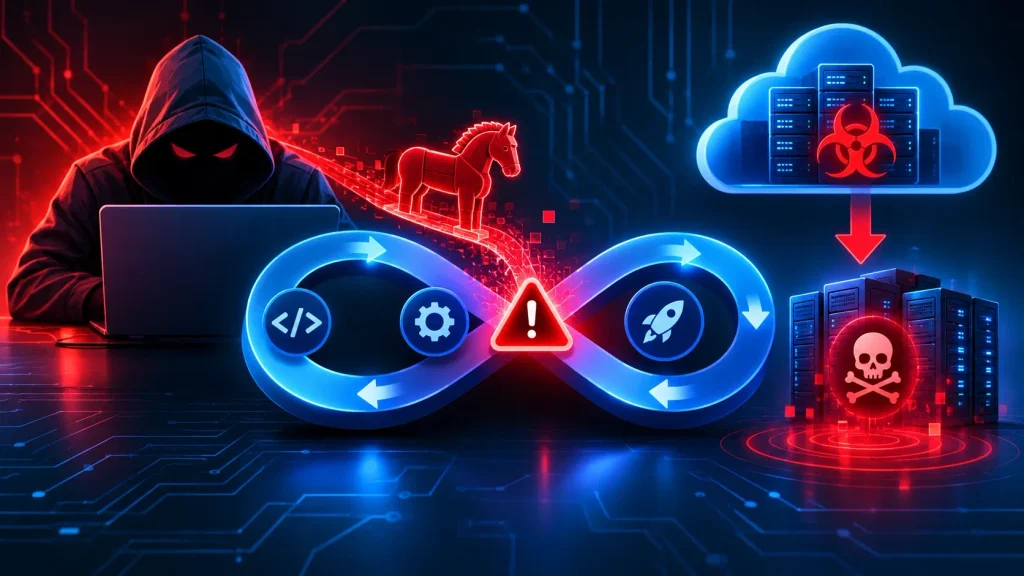
Your CI/CD pipeline is your key to the castle. It checks out code, runs third-party tools, and often has secrets for cloud accounts, package registries, and production servers. This makes it a very appealing target, and many pipelines are protected much less securely than production.
There are many real life instances. In 2021, attackers compromised Codecov’s Bash Uploader script, which thousands of pipelines performed, to silently exfiltrate environment variables, including credentials, to an attacker-controlled site.
In March 2025, the popular GitHub Action tj-actions/changed-files suffered a breach (CVE-2025-30066) that exposed secrets in public build logs. Common vulnerabilities include third-party actions that are not pinned, overly permissive tokens, self-hosted runners that remain across jobs, and pull request workflows that run untrusted code with trusted permissions. Many software supply chain assaults succeed because a pipeline trusted something it shouldn’t.
How An SBOM Improves Security?
A Software Bill of Materials, or SBOM, is a machine-readable list of every component in a piece of software, like an ingredient label. The two major formats are SPDX and CycloneDX. Governments have been pushing the notion since US Executive Order 14028 in 2021 and guidance is currently published by NIST and CISA.
And why matters that? When a new vulnerability like Log4Shell arises, the first question we always ask is “Are we affected?” Teams spend days scrambling, without an SBOM. One lets you search your inventory in minutes and determine exactly which goods have the susceptible component in them and what version An SBOM won’t prevent a software supply chain assault, but it offers you the visibility to detect and respond much more quickly. For best results, automatically generate it during every build, and combine it with vulnerability data.
Best Practices To Protect Your Software Supply Chain
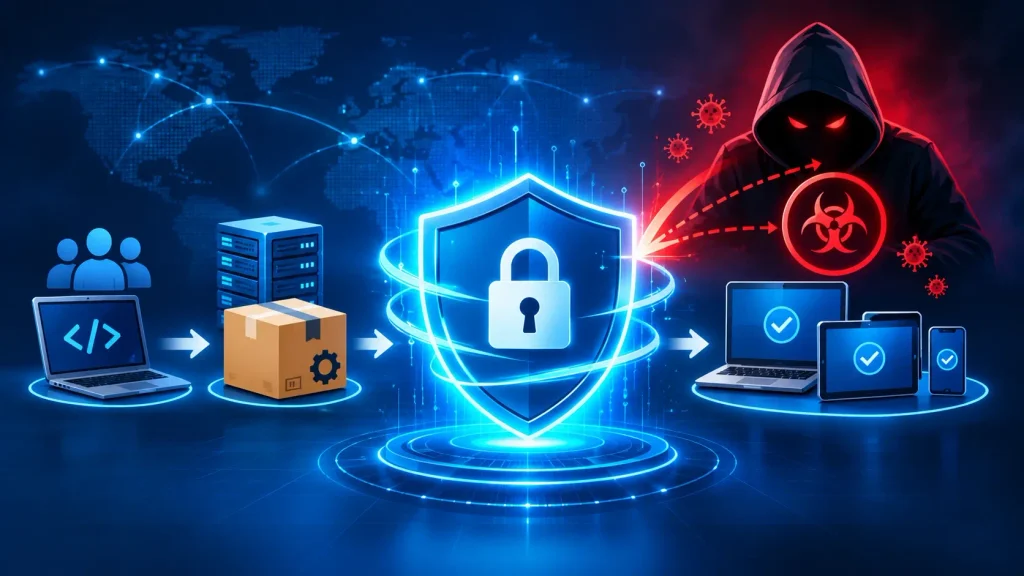
There is no single solution to thwart attacks on the software supply chain – stack your defences.
Pin and verify dependencies: Use lockfiles, exact versions and hash checking, and see what changes as you update
Lock down your registries: Use scoped namespaces. Use a private proxy registry. Publicly claim your internal package names.
Lock down your CI/CD pipeline: Limit third-party actions to full commit SHA, use least privilege for each job, use short-lived credentials, and run builds on ephemeral runners.
Protect maintainer and developer accounts: Require phishing-resistant multi-factor authentication for any user that can publish or merge.
Sign and attest your builds: Tools like as Sigstore and the SLSA framework enable you verify that an artefact came from the pipeline you anticipate.
Scan continuously: Software composition analysis and secret scanning should be executed on every pull request, not once each quarter.
Keep an SBOM for every release: Store it and check against fresh vulnerability disclosures.
Follow a framework: NIST’s Secure Software Development Framework (SP 800-218) and OWASP advice provide a checklist to assess yourself against.
Final Thoughts
Software supply chain attacks work because they feed on trust, not simply vulnerabilities. Attackers go after the weakest link upstream, from SolarWinds to XZ Utils, and allow your own update process deliver the payload. Visibility, solid identity controls and a hardened build process substantially improve your odds. Start small: catalogue your dependencies, protect your pipeline, and make verification second nature.
Frequently Asked Questions
1. What is a software supply chain attack?
These are cyber attacks against the code, tools and vendors that produce software – not the finished program. Malicious code is disguised as a trusted component, so anyone who installs or updates it will get it automatically.
2. How can I detect if a npm package or a PyPI package is malicious?
Look for red flags: a name that is one letter off from a popular package, a brand new publisher, a very low number of downloads, and unexpected install scripts or network requests. Software supply chain attacks sometimes rely on lookalike names so check the publisher and the repository link before you install anything.
3. Can an SBOM stop software supply chain attacks?
Not on its own. An SBOM is an inventory, not a protection. It’s benefit is speed: when a vulnerable or compromised component becomes announced, you can determine within minutes which of your goods include it and act on it.
4. What’s the difference between dependency misunderstanding and typosquatting?
Typosquatting depends on a developer producing a typo. With dependency confusion, there doesn’t even need to be a mistake: the build tool itself chose the attacker’s public package over your private one. Both are attacks on the software supply chain, both are mitigated by scoped namespaces and pinned, validated dependencies.
5. What should a small team do initially to fight software supply chain attacks?
Three cheap wins: enable multi-factor authentication for all accounts that can publish or merge code, commit lockfiles so versions stay stable, and generate an SBOM for each release. Then go to hardening your CI/CD pipeline.
Try Our Tools
Ready to practise with this? Use our free tools at ExplainMeTech Tools page to verify, test and understand your digital security, so you can catch weak points before they grow into software supply chain attacks aimed at your own projects. Spend a few minutes exploring them, then choose the ones that fit your workflow.
References
- OWASP. A03:2025 Software Supply Chain Failures, OWASP Top 10
- NIST. SP 800-218, Secure Software Development Framework (SSDF) Version 1.1
- Microsoft Security Blog. Analyzing Solorigate, the compromised DLL file that started a sophisticated cyberattack
- Google Security Blog. Introducing SLSA, an End-to-End Framework for Supply Chain Integrity
- CISA. Software Bill of Materials (SBOM)
If you want more technology, cybersecurity and digital-security ideas, head on over to ExplainMeTech.com and see our latest guides, tools and insights.